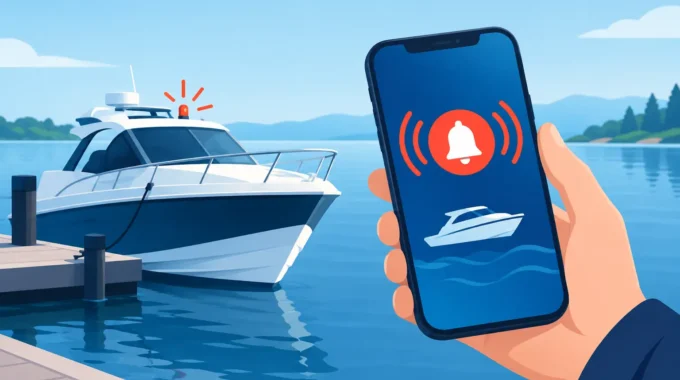
Learn how to receive boat alarm notifications by SMS, app and camera image, so you can act before flooding, fire, theft or power loss worsens at sea.
Marina Flood Prevention for Unattended Boats
A boat does not need a dramatic hull breach to sink at a marina. A failed bilge pump, a flat battery, a split hose or a leaking deck fitting can put water aboard quietly for hours. Effective marina flood prevention is about detecting that change early enough for somebody to act, before the water reaches electrical systems, engines, cabins and neighbouring vessels.
For owners who leave a yacht, cruiser, houseboat or work vessel unattended, the risk is not theoretical. A boat can look perfectly secure when you leave on Friday and be sitting low by Monday morning. By then, the damage is rarely limited to a wet bilge.
Why boats flood at the berth
Most marina flooding incidents begin with a small failure rather than a spectacular accident. A hose clamp loosens, a seawater intake weeps, a cockpit drain blocks with leaves, or rainwater finds its way through a hatch seal. On older vessels, failed transom fittings, ageing skin fittings and deteriorated plumbing deserve particular attention.
The bilge pump is usually the last line of defence, not the solution to every problem. If it runs continuously because a leak is outpacing it, the battery can be drained. If shore power trips, a battery charger fails or a battery reaches end of life, the pump may stop when it is needed most. Even a good pump cannot discharge water through a blocked outlet or overcome a major ingress point.
Marina conditions can make matters worse. Heavy rain, wash from passing vessels, king tides and wind-driven spray can expose weaknesses that are not obvious in calm weather. A vessel that is left with open scuppers, poorly secured hatches or inadequate covers is inviting trouble during the next storm cell.
Marina flood prevention starts before the alarm
A reliable flood-prevention plan begins with physical inspection. Check the bilge for fresh water, oil, debris and signs that a pump has been cycling. Inspect hoses, clamps, seacocks, through-hull fittings and pump discharge lines. Test high-water alarms and float switches rather than assuming they work because the pump ran last season.
Also check how the vessel behaves when no one is aboard. Is the battery bank being maintained? Is shore power actually present at the boat? Has a circuit breaker tripped? Are automatic bilge pumps wired correctly with a dedicated fused supply? A pump connected only through a master battery switch can be disabled the moment the boat is shut down and locked up.
There are trade-offs. Leaving every system powered can create unnecessary battery load, while switching everything off can leave critical protection unavailable. The right arrangement depends on the vessel, its electrical system and how long it is left unattended. Critical safety circuits need to remain live, protected and regularly tested.
Keep the bilge pump system honest
Bilge pumps need more than a quick press of the manual switch. Lift each float switch or use its test function, then confirm water is actually discharged overboard. Check the discharge outlet for a clear flow and make sure the non-return arrangement, where fitted, is not restricting output.
Clean debris from the bilge and confirm the pump intake is not sitting above the lowest point where water collects. On larger boats, separate compartments may need separate pumps and alarms. A catamaran, for example, can have risks in both hulls as well as machinery spaces, lockers and bridgedeck areas.
A high-water alarm should sit above the normal pump activation level. That way, it tells you the pump is not keeping up, the water has reached an abnormal level, or the primary pumping system has failed. It is the alarm that turns a hidden problem into an actionable event.
Remote monitoring closes the unattended gap
No owner can inspect a boat every few hours, especially when it is berthed interstate, used as a holiday vessel or left on a swing mooring. Remote monitoring provides the warning that a marina walk-through may not provide until it is too late.
For flood protection, the useful alerts are not limited to a single bilge sensor. You need visibility of high bilge water, bilge-pump activity, battery voltage and shore-power status. These conditions often connect. Repeated pump operation may indicate a leak. Low voltage may mean the pump is about to lose its power source. Shore-power loss may explain why the charger is no longer maintaining the batteries.
A proper marine monitoring system should send an alarm directly to nominated mobiles, not wait for you to open an app and notice a notification. The ability to alert up to five contacts gives you options if you are offshore, overseas or unable to get to the marina. One person can call the marina office, another can contact a nearby friend, and an authorised person can attend the vessel.
Visual confirmation matters too. A camera image triggered by an alarm can help distinguish a genuine emergency from a nuisance event. You may see that the boat is listing, a cockpit is holding water or a hose has come free. Equally, an image can prevent a wasted late-night call-out when the cause is obvious and contained.
Trek Transponder systems are designed for this type of unattended-vessel risk, combining once-per-second monitoring with SMS and app alerts, HD camera images and low-current marine hardware rated to IP67. For vessels beyond ordinary mobile coverage, a Starlink-enabled configuration can maintain remote visibility far from the home marina.
Set alarm rules that lead to action
An alarm is only useful if everyone knows what happens next. Do not configure a high-water warning, silence it and assume the problem can wait until morning. Water ingress changes quickly, particularly when a pump is cycling against a persistent leak.
Create a simple response plan for each vessel. The owner, marina contact, nearby skipper or paid caretaker should know who has keys, where the shore-power pedestal is, how to isolate power safely and which seacocks can be closed. They should also know when not to act alone. If there is smoke, fire, a strong fuel smell, electrical arcing or significant flooding, emergency services and marina management need to be involved immediately.
For a commercial fleet or a group of managed vessels, assign contacts by priority and location. A technician 10 minutes away is often more useful than an owner two hours away. Make sure contact numbers are current, and test the escalation path at least twice a year.
Treat shore power as part of flood protection
Shore power is often discussed as a convenience issue, but it can become a flood issue when battery charging supports automatic pump operation. If shore power fails, a charger trips or the pedestal supply is disconnected, batteries may gradually fall below a safe operating level.
Monitoring shore-power loss and battery voltage together gives earlier warning than a bilge alarm alone. It allows you to fix the cause before a rain event, a leak or an extended pump cycle turns a charging fault into a sinking risk. This is especially valuable for vessels with refrigeration, security systems and other continuous loads.
Prepare for weather, not just equipment failure
Before severe weather, clear cockpit drains, secure covers, close hatches and inspect lines and fenders. Check that the boat has enough clearance for expected tide changes and that mooring lines will not chafe or hold the vessel in a position where water can enter through an opening.
After heavy rain or strong wind, do not rely on the fact that your neighbour’s boat looks fine. Every vessel has different drain paths, fittings and weak points. Review monitoring alerts, check camera images where available and arrange an inspection if pump activity or water alarms have occurred.
Insurance may help with some financial loss, but it will not quickly replace a damaged engine room, soaked wiring loom, personal gear or a season of boating. Prevention costs far less than recovery, and early warning gives you the one thing a flooded boat does not offer: time to act.
Before your next period away from the marina, test the pump, verify the batteries, confirm your alarm contacts and make sure someone can reach the boat. A small leak is manageable. An unseen leak over a long weekend can become a write-off.
Related Posts