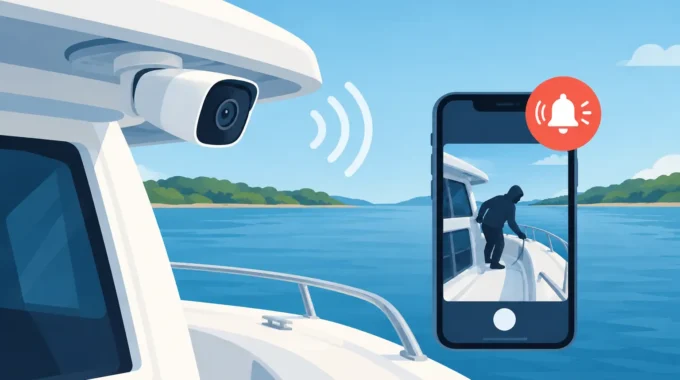
Learn how to set camera alarm snapshots on your boat, so a bilge, power, fire or security alert arrives with visual proof you can act on fast remotely.
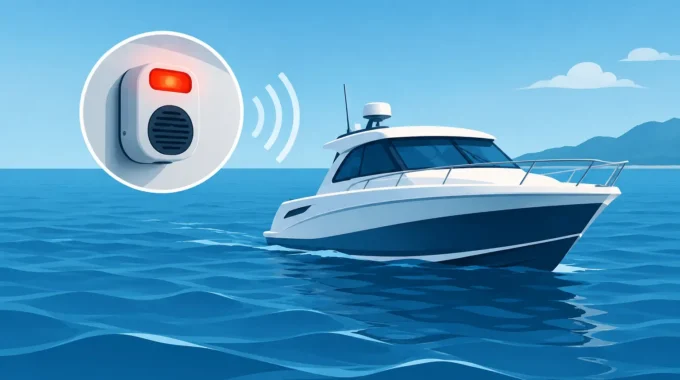
Do Boat Alarms Work Offshore? What Matters
A bilge alarm is no help if the message never leaves the boat. That is the hard truth behind the question, do boat alarms work offshore? They can, but only when the alarm system, its communications path and its power supply are designed for where the vessel actually operates. A standard 4G boat alarm may protect a yacht brilliantly in a marina, on a mooring or in coastal mobile coverage. Once the vessel is beyond that coverage, it needs a different way to report trouble.
For an owner, the stakes are high. A flat house battery can stop a pump. A failed pump can turn a small leak into a flooded saloon. Shore-power loss can spoil refrigeration or leave batteries discharged. At anchor, a dragged anchor or failed mooring can put a vessel onto a lee shore before anyone ashore knows there is a problem. Offshore monitoring is not about receiving more notifications. It is about getting the one warning that gives you time to act.
Do boat alarms work offshore without mobile coverage?
Not if they rely solely on 4G or mobile SMS. A 4G alarm needs a functioning mobile network to send an SMS, MMS image or app notification. Far enough from shore, behind an island, in a remote anchorage or in an area with poor reception, that path disappears. The alarm may still detect a high bilge level, smoke, battery failure or unauthorised entry, but it cannot alert you remotely until it reconnects.
That does not make 4G monitoring unsuitable. It is highly effective for the way many Australian boats are used: left in a berth, on a trailerable houseboat mooring, in a marina pen or at anchor within coastal reception. The mistake is assuming that a mobile-based alarm provides global coverage simply because your mobile does.
For genuine offshore operation, the system needs satellite-backed connectivity. A Starlink-enabled vessel monitoring setup can provide an internet path where terrestrial mobile service cannot. Provided the onboard Starlink equipment is online and has a clear view of the sky, the alarm can send alerts and camera images through the satellite connection rather than waiting for 4G signal.
Detection and delivery are two separate jobs
A reliable offshore alarm system has to do two things well. First, it must detect the fault accurately. Second, it must deliver the warning through whatever communications method is available. Many owners focus only on the alert arriving on their mobile. The sensor and its installation matter just as much.
A water sensor mounted too high may give a warning only after serious flooding has begun. A battery monitor that only reports voltage may not reveal a failed charger, shore-power loss or a heavy draw early enough to protect the bank. An intruder contact that is fitted to only one access point leaves the rest of the boat unprotected.
The best setup monitors the causes and the consequences. It can identify shore-power failure before batteries run down, detect bilge-pump activity before the float switch is overwhelmed, and send a high-water alarm if pumping is not keeping up. It can also monitor smoke or fire, refrigeration temperature, movement, pitch and roll, anchor drag, and a vessel going adrift.
Once-per-second monitoring is valuable here. A boat can go from a normal heel to an abnormal angle quickly in a squall, and a bilge level can change fast after a hose failure. Slow polling may be acceptable for a casual status check. It is not the same as active protection for a vessel that may be unattended for days.
Alarms need a clear action behind them
A message that says “alarm” is not enough when you are hours away. Useful alerts identify the problem and the vessel, then go to several people who can respond. Sending direct alarms to up to five mobile numbers gives the owner, marina contact, skipper, family member and service technician a chance to act before a small issue becomes an insurance claim.
Camera confirmation is equally practical. If a motion alarm sends an HD image, you can distinguish a person on deck from a loose cover moving in wind. If an anchor alarm triggers, a camera image may show whether the vessel is swinging normally, taking water over the bow or drifting into danger. It does not replace a response, but it stops guesswork wasting critical minutes.
What can prevent an offshore boat alarm from working?
Satellite connectivity improves the communications path, but it does not remove every failure point. Offshore equipment lives with vibration, salt spray, heat, condensation and intermittent power. A monitoring system must be installed and maintained as part of the boat’s safety equipment, not treated like a consumer gadget.
Power is the first dependency. The alarm should have extremely low current draw, because it may be the only device continuously operating while the vessel is unattended. It should also be wired and protected properly so a fault on another circuit does not silence the monitoring system. Battery alarms, low-voltage warnings and shore-power monitoring are not optional extras when the communications equipment itself depends on stable onboard power.
The second dependency is antenna and satellite performance. Starlink needs an unobstructed sky view. Masts, booms, radar arrays and hardtops can affect placement. Before relying on it offshore, test the system in the way you use the vessel: at the berth, underway, at anchor and with typical loads running. Check that alerts arrive promptly and that images can be requested when needed.
The third is the marine rating of the hardware. Electronics installed below decks may still face damp lockers, spray through openings and bilge humidity. IP67-rated alarm hardware provides protection against dust and temporary immersion, but correct mounting, sealed cable entries and tidy wiring remain essential. An IP rating is not a licence for poor installation.
Finally, every alarm needs sensible settings. An overly sensitive movement or anchor-drag alarm can create nuisance alerts that owners learn to ignore. Set operating zones, delays and escalation rules to suit the vessel, anchorage and weather. Test them after installation. A good system should warn you early without crying wolf every time a ferry wake rolls through.
Offshore monitoring should cover more than security
Break-ins get attention because they are visible. The expensive damage often comes from quieter failures: a bilge pump cycling continuously, a charger tripping, a fridge failing on a long passage, or a small electrical fault developing into smoke or fire. Offshore, those risks are magnified because help is further away and recovery options are limited.
That is why a serious system should combine security, safety and vessel status in one view. Door contacts, deck movement detection and cameras protect against intrusion. Bilge, pump, smoke and fire monitoring protect the vessel itself. GPS position, anchor drag and heel or roll alerts help confirm whether the boat is where it should be and behaving normally. Battery, shore-power and refrigeration monitoring protect the systems that keep it operational.
For larger yachts, commercial vessels, hire fleets and catamarans, one unit may not be enough. Separate accommodation areas, machinery spaces, hulls or access points can require multiple monitoring units. The goal is not to fill the boat with sensors. It is to remove blind spots where a failure could develop unseen.
Choose the communications plan for your real cruising grounds
Start with an honest map of where the boat spends its unattended time. If it is normally in an Australian marina or coastal anchorage with reliable reception, a 4G SMS and app-based alarm may be the practical, cost-effective choice. It can send immediate alerts, trigger lights or sirens, and provide camera images without relying on marina Wi-Fi.
If you regularly travel beyond mobile range, leave the vessel in remote areas or want continuous oversight during offshore passages, specify satellite-backed monitoring from the outset. Do not assume you can solve the problem by fitting a satellite tracker alone. Tracking tells you where the boat is. It may not tell you that the bilge is rising, the batteries are failing or the refrigeration has stopped.
Trek Transponder systems are built for this real-world distinction, with Australian-made, IP67-rated alarm hardware, direct mobile alerts and Starlink-enabled options for global connectivity. Compliance with AS/NZS 3004.2:2014 also matters when the system is integrated into a vessel’s electrical environment. Fit it correctly, configure the right alarms and nominate people who will answer when the alert arrives.
Before your next offshore trip, test the alarm while you are still close enough to fix any weakness. Trigger each sensor, confirm every nominated mobile receives the right message, request a camera image, check backup power and verify satellite communication away from shore. The best time to discover an alarm cannot reach you is at the dock, not when your boat is over the horizon.
Related Posts