
Does Starlink work offshore? Coverage, power, weather and installation all determine whether your boat stays connected beyond the marina or at anchor.
How to Check Boat Battery Voltage Remotely
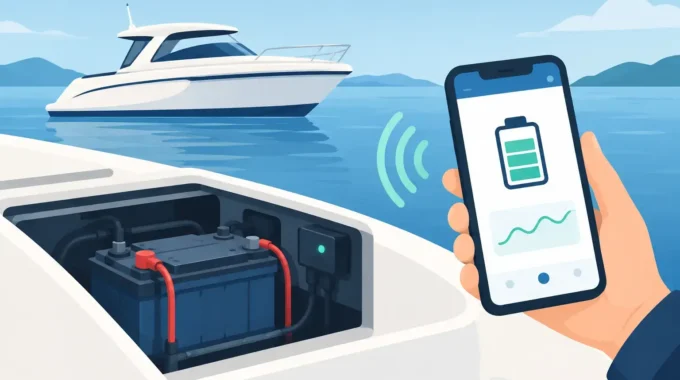
A flat battery is rarely just a flat battery. On an unattended boat, it can mean the bilge pump stops, refrigeration fails, alarms go silent and the vessel is left vulnerable before anyone at the marina notices. The ability to check boat battery voltage remotely gives you an early warning of a charging problem, shore-power failure or battery bank that is heading towards collapse.
For boats left on a berth, swing mooring, marina pen or trailer storage, voltage monitoring is one of the simplest ways to know whether critical onboard systems still have power. It is not a replacement for proper battery maintenance, but it gives you time to act before an avoidable fault becomes a flooded cabin, spoiled stores, damaged batteries or an insurance claim.
Why remote battery voltage checks matter
Your battery bank supports far more than engine starting. House batteries may run bilge pumps, navigation equipment, security systems, communications, lighting, refrigeration and automatic fire or intrusion alarms. If shore power trips, a charger fails or a corroded connection interrupts charging, those loads keep drawing power.
A vessel can look perfectly secure from the dock while its batteries are discharging below deck. By the time a neighbour sees a dark cabin or hears a low-voltage alarm, the useful response window may have passed. This is especially serious after heavy rain, when bilge-pump demand rises at the same time as a depleted battery bank loses its ability to protect the boat.
Remote monitoring puts the voltage reading in front of you when you are at home, travelling interstate or away from the marina for weeks. More importantly, a properly configured system can alert you when voltage crosses a set threshold, rather than relying on you to remember to check an app every day.
What battery voltage is telling you
Voltage is a useful indicator, but it must be interpreted in context. A 12-volt lead-acid battery at rest will generally read around 12.6 to 12.8 volts when fully charged. Around 12.4 volts suggests it is no longer full, while 12.2 volts is commonly treated as roughly 50 per cent state of charge. Regularly taking conventional lead-acid batteries below that point shortens their working life.
Those figures are a guide, not a diagnosis. A battery that has just been charged may show an artificially high reading because of surface charge. A battery under a heavy load will show a lower reading, sometimes briefly. Temperature, cable length, connection condition and the accuracy of the monitoring input also affect what you see.
When shore power or an engine-driven charging source is active, voltage should normally rise above resting battery voltage. Depending on the charging system and battery chemistry, charging may sit around 13.6 to 14.6 volts. A sudden fall from a normal charging voltage to a resting or declining voltage is often the first sign that shore power, the battery charger or its supply has failed.
Lithium batteries need a different approach. Their voltage curve remains relatively flat through much of the discharge cycle, so voltage alone can be less revealing than it is with lead-acid batteries. If your boat uses lithium, use the battery manufacturer’s limits and, where available, combine voltage monitoring with the battery management system’s state-of-charge data and alarm outputs.
How to check boat battery voltage remotely
The dependable method is to connect a marine-rated monitoring system to the battery bank or an appropriate fused distribution point, then configure the system to report voltage through an app, SMS alerts, or both. The monitor should remain powered from the vessel’s DC system while drawing very little current itself. Otherwise, the device intended to protect the bank becomes another unnecessary load.
Start by deciding which bank matters most. On a small boat, that may be the combined house and start bank. On a larger yacht, cruiser or commercial vessel, house, engine-start, generator-start and emergency banks can each deserve their own monitoring point. A single healthy start battery does not help much if the house bank running the bilge pumps is falling away.
Set a normal baseline before relying on alarms. Record voltage with shore power connected, with charging off after the battery has rested, and during typical onboard loads such as refrigeration cycling. This tells you what normal looks like for your vessel. A threshold copied from another boat can create nuisance alerts or, worse, warn too late.
For many 12-volt lead-acid house systems, an alert above the deeply discharged range is sensible. The exact setting depends on the loads you need to preserve and how quickly you can get to the boat. An owner ten minutes from the marina may accept a lower threshold than an owner who is overseas for a month. The point is to receive an alert while there is still enough power to run safety equipment and investigate the cause.
Do not configure low-voltage alerts in isolation. Pair them with a shore-power-loss alert where practical. That combination tells a clearer story: shore power has failed, charging has stopped, and battery voltage is now declining. Add a bilge high-water or bilge-pump runtime alert and you have far better warning of the dangerous sequence that sinks unattended boats.
The fault patterns worth acting on
A remote voltage reading becomes valuable when you recognise a change, not just a number. A stable 13.8 volts while connected to shore power is usually reassuring. A gradual daily decline can indicate a charger that is underperforming, a new parasitic load, ageing batteries or refrigeration working harder than expected.
A sharp voltage drop deserves immediate attention. It may be a shore-power pedestal trip, a disconnected lead, a failed charger, a tripped breaker or a battery isolation switch moved accidentally. After storm activity, check whether water has reached electrical connections, whether bilge pumps have been cycling excessively, and whether the boat has lost mains supply.
An unusually high charging voltage also matters. Overcharging can boil lead-acid batteries, accelerate water loss and create a serious safety risk in an enclosed space. For lithium systems, charging settings must match the battery manufacturer’s instructions and battery management system requirements. Remote monitoring should prompt inspection, not encourage guessing at charger settings from the car park.
If voltage appears normal but the boat is still behaving oddly, do not assume the electrical system is healthy. A poor connection, blown fuse, failed pump, damaged battery cable or isolated circuit can leave voltage visible at one point while a critical device has no usable supply. This is why camera confirmation and separate alarms for bilge level, fire, intruder detection and shore power are worth considering.
Choose monitoring built for an unattended vessel
A consumer tracker or a basic voltage display is not enough for a boat that spends long periods unattended in salt air, heat, vibration and rain. The hardware needs to be marine-specific, properly protected against water ingress and installed with correct fusing and cable routing. It should continue monitoring through normal marina conditions without relying on a nearby Wi-Fi connection that may disappear when you need it most.
Communication matters as much as sensing. App notifications are convenient, but direct SMS alerts provide another path when an app is closed or data coverage is poor. A system that can alert several mobile numbers means a family member, marina manager, skipper or fleet contact can act if you are out of reach.
Trek Transponder systems are designed for this job, with once-per-second vessel monitoring, low current draw and alarms sent directly to up to five mobile numbers. For an owner trying to confirm whether a voltage alarm is a genuine emergency, alarm-triggered HD camera images can show whether the boat is dark, flooded, disturbed or still safely in place.
On larger vessels, multiple monitoring points may be appropriate. A catamaran with separate hull systems, a vessel with an inverter bank, or a commercial operator managing several boats has more failure paths than a simple runabout. The right installation is based on critical circuits, battery-bank layout and the consequences if each bank fails.
Voltage monitoring is an early warning, not a maintenance plan
Remote readings do not remove the need to inspect batteries, clean terminals, test chargers and check electrolyte levels where applicable. Nor can voltage alone prove a battery still has its rated capacity. A weak battery can show a healthy resting voltage and then collapse under a starter load or sustained bilge-pump demand.
Use remote voltage checks to decide when to attend the vessel before a small issue becomes costly. If the trend is wrong, arrange for someone to inspect shore power, charging equipment, battery condition and onboard loads promptly. If a low-voltage alert arrives alongside a bilge or power alarm, treat it as urgent.
Your boat does not need to be far offshore to suffer a major electrical failure. It only needs to be unattended long enough for a flat battery to stop the one system keeping water out. Set the alerts, test them while you are nearby, and make sure the right person can respond when your boat calls for help.
Related Posts