Five risks unattended vessels face can escalate fast. Learn what to monitor remotely to prevent flooding, fire, theft and costly damage at your berth.
Shore Power Alarm Protection for Unattended Boats
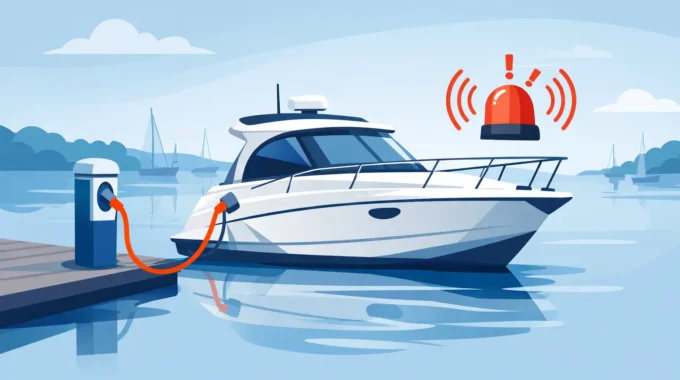
A tripped marina breaker can look harmless from the dock. A few hours later, your batteries are no longer charging. By morning, refrigeration may be warm, bilge-pump reserve is reduced and a boat that was secure when you left has become an expensive problem. A shore power alarm gives you the warning while there is still time to act.
For boats left in a marina berth, on a swing mooring with occasional power, or in dry storage, shore power is often carrying more responsibility than owners realise. It supports battery chargers, refrigeration, dehumidifiers, lighting, pumps and equipment that keeps the vessel ready to go. When it fails, the consequences depend on what is running, the battery bank condition and how long nobody knows about it.
Why shore power loss becomes a vessel emergency
Shore power does not always fail because someone unplugged your lead. A marina pedestal can trip after rain or a local fault. A circuit breaker may be knocked off. A shore lead can be damaged, partially disconnected or overloaded. A charger fault can also stop batteries receiving charge even when the dock supply is still live.
The first loss is usually quiet: AC power disappears and the charger stops. Your vessel then runs from its battery bank. If the fridge, freezer, monitoring equipment, lights or other DC loads remain on, voltage begins to fall. Once batteries are low, the systems you depend on during an emergency can be compromised.
The bilge pump is a prime example. A pump may continue operating for some time on battery power, but a persistent leak, heavy rain or failed float switch can consume the available reserve. A shore-power failure does not create flooding by itself. It removes a layer of protection and can turn an otherwise manageable fault into a sinking risk.
Refrigeration failure is another common and costly result. A flat battery bank can leave a fridge or freezer warm for days before the next visit. On commercial, charter and liveaboard vessels, that can mean spoiled stores, odour, corrosion and a substantial clean-up. On larger yachts, it may also affect specialised refrigeration systems that should never be left without oversight.
What a shore power alarm should actually detect
A useful shore power alarm monitors the presence of the incoming AC supply, not merely the state of the batteries. Battery voltage tells you there is a problem, but it may only report the result after the charger has been off for some time. Direct shore-power detection can warn you as soon as the supply disappears.
That distinction matters. If your battery bank is healthy and the fridge load is modest, voltage could appear normal for hours after the marina power fails. By then, a simple breaker reset may have become a flat-battery recovery job.
The alarm should send a clear message to the people able to respond. An onboard siren is useful when somebody is nearby, but it does nothing for an owner at home, interstate or overseas. Remote SMS alerts to multiple mobile numbers are practical because they do not require someone to be watching an app at the exact moment a fault occurs. App notifications add value too, particularly where you want to check the vessel’s live status and alarm history.
For a boat with valuable equipment or a long distance between the berth and the owner, visual confirmation is worth having. A camera image requested remotely or triggered by an alarm can show whether the vessel is dark, whether the fridge area has leaked, or whether the shore lead appears displaced. It does not replace attendance, but it helps you decide whether to call the marina, a neighbour or your marine technician.
The alarm is only as good as its power arrangement
There is an obvious question: if shore power fails, how does the shore power alarm keep working? The monitoring system must have a properly maintained DC battery supply independent of the incoming AC power. It needs to remain active long enough to detect the loss, send the alert and continue monitoring the vessel.
Low current draw matters here. A monitoring system that consumes excessive power undermines the very battery reserve it is there to protect. Marine-rated hardware also matters. The cabin or engine space is not a clean, dry office environment. Heat, vibration, salt air and moisture punish poorly suited equipment.
For permanent installation, the system should be fitted neatly with correct circuit protection and sound wiring practices. On vessels with substantial AC systems, speak with a qualified marine electrician or preferred installer. The AC side of the boat is not the place for improvised connections. Compliance with AS/NZS 3004.2:2014 is a serious consideration when assessing electrical work and equipment on Australian vessels.
Avoid the false reassurance of one alarm
Shore power loss is a critical alarm, but it should sit alongside the other faults that can damage an unattended vessel. A charger may be operating but battery voltage may still fall due to a failing battery. Shore power may be present while a bilge pump runs continuously because of a leak. A fridge may fail even though the dock supply is sound.
A sensible monitoring plan combines shore-power detection with battery voltage, high-water or bilge alarms, bilge-pump activity, fire and smoke detection, intrusion alerts and temperature or refrigeration monitoring where relevant. Larger boats, catamarans and vessels with separated hulls or machinery areas may need more than one monitoring unit or sensor location. The right arrangement depends on the vessel layout and the consequence of missing an event.
Set the alert so someone will act
An alert sent to one mobile is better than none, but it creates a single point of failure. The owner may be in flight mode, out of coverage or simply unable to get to the marina. Set critical alerts to reach several trusted contacts, such as a co-owner, marina neighbour, vessel manager or skipper.
Each person needs to know what the message means and what they are authorised to do. A simple response plan avoids delay: check whether the marina has a known outage, inspect the pedestal and onboard breakers if safe to do so, confirm the shore lead is secure, and escalate to an electrician if a fault is suspected. If battery voltage is falling or a bilge alarm is also active, the response should be immediate.
Do not set a long delay merely to avoid nuisance alerts. Brief brownouts happen, and a short confirmation period can prevent needless messages, but a delay of several hours defeats the point. The ideal timing depends on the marina’s reliability, the loads left running and the battery capacity. A vessel relying on shore power for refrigeration and pumping deserves a faster warning than a lightly equipped boat in attended storage.
Test it before you depend on it
A shore-power monitoring feature should be tested at commissioning, then tested routinely. With the vessel secure and safe, isolate the shore supply at the appropriate point and confirm that the alert reaches every nominated mobile. Check the wording of the message, the time it takes to arrive and whether the monitoring system remains online on battery power.
Then restore power and make sure the system reports recovery if that function is enabled. A recovery notification is useful because it prevents uncertainty after a marina outage or a caretaker reset. It also creates a record that the supply was restored, rather than leaving you to assume the issue has been resolved.
Testing should include the real conditions of ownership. If you use an app, check it away from the marina. If alarms are sent by SMS, verify every nominated mobile number. If cameras are part of your response plan, request an image and make sure the view is useful. A camera pointed at a bulkhead cannot confirm a displaced shore lead or a flooded cabin sole.
Choose marine monitoring, not a household workaround
A domestic smart plug or Wi-Fi power monitor may tell you that a socket has gone offline, but it is rarely a complete answer on a boat. Marina Wi-Fi can be unreliable, household equipment is not designed for wet, vibrating marine conditions, and an internet outage can look identical to a power failure. More importantly, these devices generally do not continue monitoring the vessel’s batteries, bilges, security and fire risks.
Purpose-built systems are designed to keep watch when the boat is unattended. Trek Transponder systems monitor critical vessel conditions once per second, can send direct alarms to up to five mobile numbers and support alarm-triggered or requested HD camera images. Their low-power, IP67-rated marine hardware is made for the realities of Australian boating, not for a shelf beside the home router.
The most expensive shore-power failure is not the one that trips a breaker. It is the one nobody discovers until the batteries are ruined, the freezer has failed or the bilge has been running flat out for days. Fit a shore power alarm, test the response path and leave the berth knowing that silence from your boat is not your only line of defence.
Related Posts